
EQ vs. IQ: What’s the Difference and Why It Matters
Most people have heard of IQ (intelligence quotient) and EQ (emotional intelligence), but the distinction between them—and their impact at work—is often misunderstood. Understanding how each works can help you make better decisions about hiring, development, and performance.
Key Takeaways
- IQ measures reasoning and problem-solving ability, while EQ measures how effectively you understand and manage emotions.
- IQ is assessed through standardized cognitive tests, while EQ is measured through behavioral and emotional assessments.
- Both contribute to workplace success, but EQ is more consistently tied to collaboration, leadership, and long-term performance.
- IQ tests face ongoing debate around bias and real-world relevance.
- Developing EQ improves communication, decision-making, and team outcomes in any role.
What is IQ?
“IQ stands for intelligence quotient and, in short, it is a measure of a person’s reasoning ability. In other words, an IQ test is supposed to gauge how well someone can use information and logic to answer questions or make predictions.”
The concept dates back to the early 1900s and has long been used in academic and clinical settings. However, its relevance in modern workplaces is debated.
The concept dates back to the early 1900s and has long been used in academic and clinical settings. However, its relevance in modern workplaces is debated. Jack A. Naglieri of the American Psychological Association argues that “the use of verbal and quantitative tests as measures of ability is hard to justify given that these test items are virtually indistinguishable from questions on tests of achievement.” He and many others also argue that IQ tests “amplify race and ethnic differences” and increase biases.
How is IQ Measured?
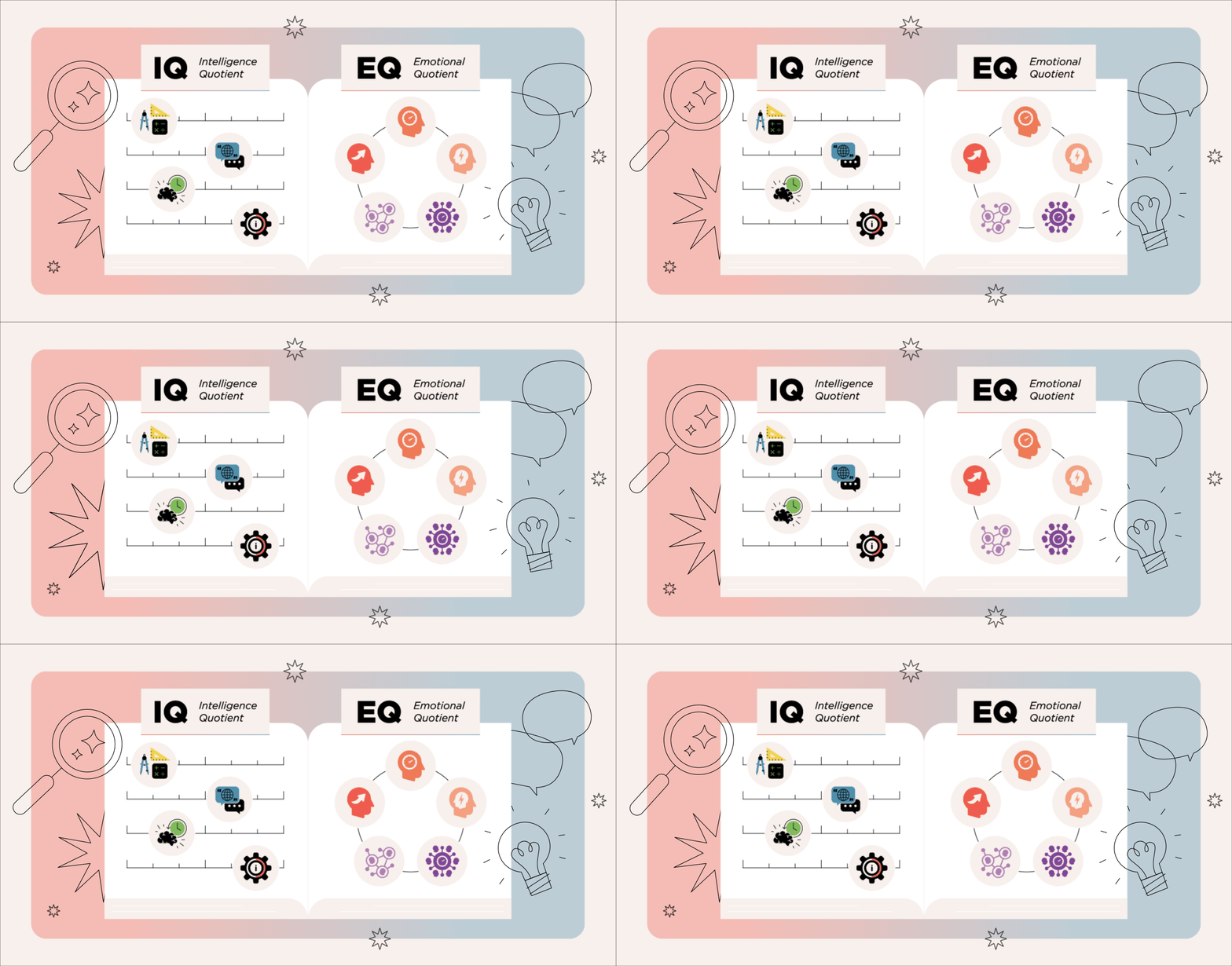
IQ is evaluated through standardized cognitive tests designed to assess performance. Healthline reports that the most used IQ tests are:
- Wechsler Intelligence Scale for Adults (WAIS)
- Wechsler Intelligence Scale for Children (WISC-V)
- Stanford-Binet Intelligence Scales
- Differential Ability Scales (DAS)
- Peabody Individual Achievement Test
These assessments generate an age-adjusted score, benchmarking cognitive ability relative to peers.
What is EQ?
“Emotional intelligence is the ability to sense, understand and effectively apply the power of acumen of emotions to facilitate higher levels of collaboration and productivity.”
The concept gained widespread attention through Daniel Goleman, building on research by Peter Salovey and John D. Mayer. Today, EQ is widely recognized as a key driver of workplace effectiveness.
How is EQ Measured?
Unlike IQ, EQ is assessed through behavioral and psychological tools, not right-or-wrong questions. High-quality assessments evaluate five core dimensions. It’s important to remember that some assessments are more reliable than others; look for science-backed, research-based assessments that evaluate five core dimensions:
Self Awareness is the ability to recognize and understand your moods, emotions and drives, as well as their effect on others.
Self Regulation is the ability to control or redirect disruptive impulses and moods and the propensity to suspend judgment and think before acting.
Social Awareness is the ability to understand the emotional makeup of other people and how your words and actions affect others.
Social Regulation is the ability to influence the emotional clarity of others through proficiency in managing relationships and building networks.
Motivation is a passion for working for reasons beyond the external drive for knowledge, utility, surroundings, others, power, or methodology and is based on an internal drive or propensity to pursue goals with energy and persistence.
Reliable EQ assessments are research-based and designed for actionable insight, not just scores.
Are IQ and EQ Connected?
Research is mixed on whether IQ and EQ are directly linked. Some studies suggest overlap through shared abilities like pattern recognition, which can support both problem-solving (IQ) and emotional awareness (EQ).
Still, one does not guarantee the other; each represents a distinct set of capabilities.
Which Matters More in the Workplace?
There’s no universal winner, but EQ often has a broader impact at work.
While IQ supports technical skills and analytical thinking, EQ drives how work gets done—especially in team environments. Skills like communication, adaptability, empathy, and conflict management are rooted in emotional intelligence and apply across nearly every role.
Workplace trends reinforce this shift, with emotional intelligence consistently ranked as a top in-demand skill globally.
That said, top performers balance both IQ and EQ. IQ helps solve problems, but EQ determines how effectively those solutions are applied with others.
How to Apply EQ Insights
If you’re developing talent, hiring, or improving team performance, consider evaluating both cognitive ability and emotional intelligence. IQ can indicate how someone thinks, while EQ reveals how they work with others. Both perspectives matter, but focusing on EQ development, in particular, can lead to measurable improvements in engagement, communication, and long-term effectiveness.
Learn More About Emotional Intelligence
Building EQ is one of the most valuable investments you can make in workplace performance. If you’re ready to harness the power of EQ for individuals, teams, or your entire organization, TTI is here to help.
Curious for more information? Check out these resources:
- Drop Your Ego: How To Boost Your EQ And Abandon Arrogance
- 3 Ways EQ Makes You a Better Leader [Infographic]
- How Does EQ Help You Adapt Your Behavioral Style?
- TriMetrix® EQ: What You Need to Know