
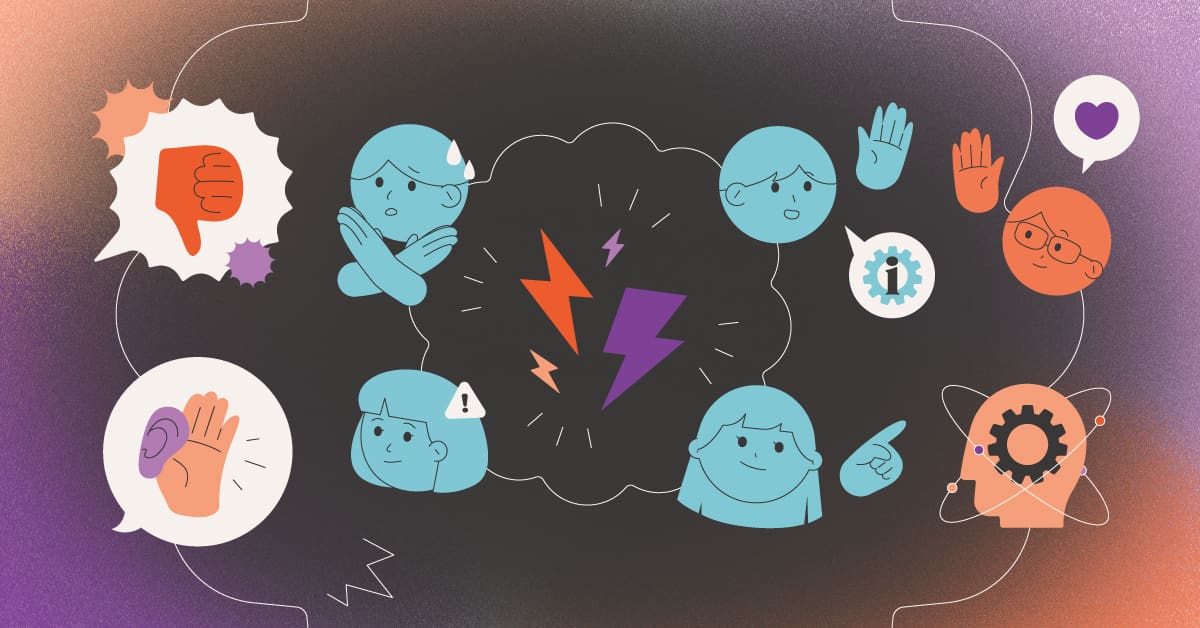
Conflict is a natural part of any relationship, whether you’re interacting with a partner, family member, friend, or coworker. Strong conflict resolution skills help you manage disagreements, improve communication, and prevent small issues from escalating into larger problems.
Key Takeaways
- Prioritize face-to-face communication to reduce misunderstandings and recognize nonverbal cues.
- Practice active listening by paying attention, processing what the other person says, and asking clarifying questions.
- Address behaviors instead of attacking people to reduce defensiveness and encourage productive conversations.
- Take responsibility for your role in a conflict by acknowledging your actions and considering the other person’s perspective.
- Build self-awareness to better understand your own communication style and how it affects your relationships.
Here are four ways to improve your conflict resolution skills and build healthier relationships through better communication.
1. Prioritize Face-to-Face Communication
When you’re frustrated with someone, it can be tempting to send a series of angry text messages. However, face-to-face communication can help prevent misunderstandings by making tone of voice, body language, and facial expressions easier to interpret.
Text messages and emails lack many of the nonverbal cues that help people understand one another. As a result, your intentions may be misconstrued, making an already difficult situation worse.
During disagreements, pay attention to your body language. Crossing your arms may communicate that you’re closed off, while aggressive gestures can make the other person feel defensive. Instead, aim for a relaxed posture, natural eye contact, and facial expressions that reflect your engagement in the conversation.
At TTI, feedback is delivered face-to-face to help ensure that communication is effective, kind, and constructive. This approach reduces the need to guess at tone or meaning and creates opportunities to clarify misunderstandings in real time.
How to apply this conflict resolution strategy: When a disagreement arises, consider having a face-to-face conversation instead of relying on text messages. Choose a time when both people can speak calmly and focus on understanding one another.
2. Practice Active Listening
Face-to-face communication is an important first step, but effective conflict resolution also requires active listening skills. Listening helps people understand different perspectives, identify the source of a disagreement, and work toward a mutually beneficial solution.
Effective communication depends heavily on listening skills that reinforce two-way understanding.
To practice active listening during a disagreement, remember these three steps.
Look
Maintain open body language and steady, nonaggressive eye contact. Show the other person that you’re engaged in the conversation rather than distracted or preparing to defend yourself.
Process
Pay attention to both the words and the nonverbal cues your conversation partner uses. Their tone of voice, facial expressions, and gestures can provide additional context about how they feel.
When a conversation becomes heated, you may feel stressed or defensive. The other person might raise their voice or speak more sharply. Notice these changes without letting them distract you from the message.
Avoid planning your rebuttal while the other person is speaking. Instead, focus on understanding their perspective before deciding how to respond.
Confirm
Active listening also means asking questions to clarify what you’ve heard. This helps ensure that the other person feels understood and gives you an opportunity to address potential misunderstandings before they escalate.
Try restating a point as a question to confirm your understanding. For example, you might ask, “Are you saying that you felt left out of the decision-making process?”
Use this technique naturally rather than turning every statement into a question. The goal is to demonstrate genuine interest, not to challenge the other person’s words.
How to apply this conflict resolution strategy: Before responding to a complaint or criticism, summarize what you heard and ask whether you’ve understood it correctly. This simple practice can help both people feel heard and respected.
3. Avoid Blame and Shame
Blame and shame can quickly derail conflict resolution. When people feel criticized or threatened, they may become defensive, shift responsibility, or focus on proving who’s right instead of finding a solution.
One of the most effective communication strategies for resolving conflict is to address specific behaviors rather than attack someone’s character.
“When you’re in a situation full of conflict, you need to shift your language,” says Cassandra Nelson, a Solutions Consultant at TTI. “Instead of saying ‘I don’t like passive-aggressive people,’ shift the language to ‘I don’t respond well to passive-aggressive behavior.’ This avoids passing judgment on the individual, while still addressing the problematic behavior.”
The difference may seem small, but it can change the direction of a conversation. Criticizing someone’s character can make them feel personally attacked, while describing a specific behavior creates more room for discussion and change.
For example, instead of saying, “You’re always inconsiderate,” try saying, “I feel overlooked when my concerns aren’t addressed.”
The second statement communicates the problem without defining the other person by their actions. It also gives them a clearer understanding of what needs to change.
How to apply this conflict resolution strategy: Use specific examples and describe how a behavior affects you. Avoid generalizations such as “you always” or “you never,” which can shift the conversation toward defending past actions instead of resolving the current issue.
4. Accept Responsibility for Your Role in a Conflict
Taking responsibility can be one of the hardest parts of resolving a disagreement. It’s natural to become defensive when you believe someone else is at fault. However, acknowledging your contribution to a conflict can help rebuild trust and move the conversation toward a solution.
Try setting aside the question of who’s to blame long enough to examine what happened. Perhaps the initial mistake wasn’t yours, but you responded in anger. Maybe you overlooked something the other person considered important or failed to communicate your expectations clearly.
Consider where the interaction broke down and acknowledge your part in it. Taking responsibility doesn’t mean accepting blame for everything that happened. It means recognizing your actions and understanding how they affected the situation.
The ability to admit when you’re wrong is an important soft skill. Deloitte’s 2019 Global Human Capital Trends report highlighted the growing importance of human capabilities, including problem-solving, communication, and empathy, as automation changes the nature of work.
These skills matter in personal relationships, too. Taking ownership of your actions demonstrates a willingness to learn, collaborate, and find solutions.
When accepting responsibility, explain your actions and share your feelings without telling the other person how they feel or why they feel that way. Give them the space to describe their own experience.
How to apply this conflict resolution strategy: Acknowledge your actions directly. For example, say, “I was frustrated, and I interrupted you before you could finish. I’m sorry. I’d like to hear what you were trying to explain.” A sincere acknowledgment can help create the conditions for a more productive conversation.
Strengthen Your Conflict Resolution Skills With Greater Self-Awareness
Conflict is an inevitable part of relationships, but improving your communication skills can help you manage disagreements more constructively. By prioritizing face-to-face conversations, practicing active listening, avoiding personal attacks, and accepting responsibility, you can build stronger relationships at work and in your personal life.
Self-awareness is another important part of this process. Understanding your own behavioral tendencies and recognizing that other people may communicate differently can help you approach disagreements with greater patience and perspective.
Assessments can support this development by helping individuals understand their own behaviors and the behaviors of others. While assessments won’t eliminate conflict, they can provide insights that help people recognize communication differences, identify potential friction points, and learn from difficult interactions.
At TTI, assessments help individuals and organizations better understand the behaviors and motivations that influence how people interact. This awareness can support more effective communication, stronger teamwork, and continued personal development.
The goal of conflict resolution isn’t to avoid every disagreement. It’s to develop the communication skills and self-awareness needed to work through disagreements and move forward constructively.
Want to improve your conflict resolution skills? TTI is ready to help.